
The solar radiation sensor measures global solar radiation, that is, the sum at the measurement point of the direct, diffuse and reflected components.
Features of the solar radiation sensor
It consists of a high-precision silicon photodiode located inside a plastic housing that provides a path for air currents to cool the interior by convection, minimizing heating of the sensor.
The cutting ring provides excellent cosine response, avoiding measurement errors.
A cosine response solar radiation sensor is a device designed to measure solar radiation accurately, taking into account the variation in the angle of incidence of the radiation. Each sensor is calibrated against a secondary standard under natural light.
Eθ=E0⋅cos(θ)
- Eθ is the radiation measured at an angle θ
- E0 is the radiation when the light hits the sensor perpendicularly (θ =0 ºC).
- θ is the angle of incidence of the radiation.
The solar radiation sensor with cosine response allows measuring the amount of light available for photosynthesis (PAR – photosynthetically active radiation).
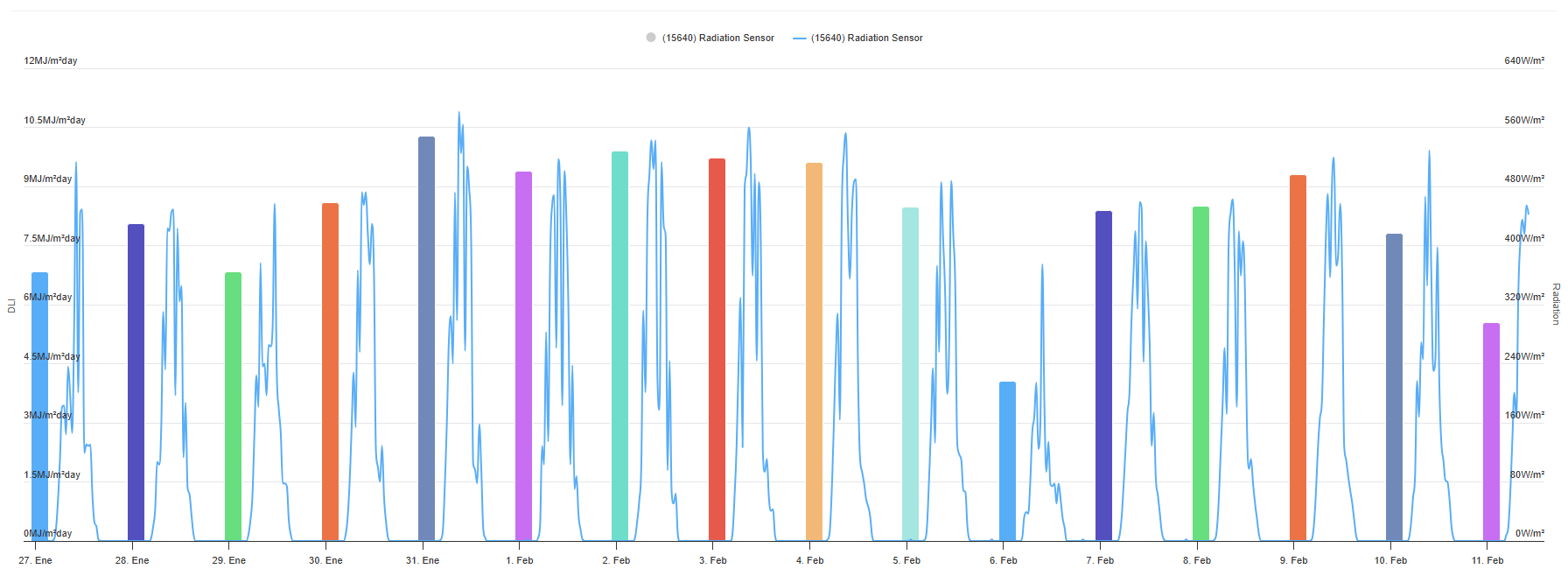
The readings are measured every 30 minutes and if we add all the readings from the same day we will have the data that we are interested in showing, the Daily Light Integral per day.
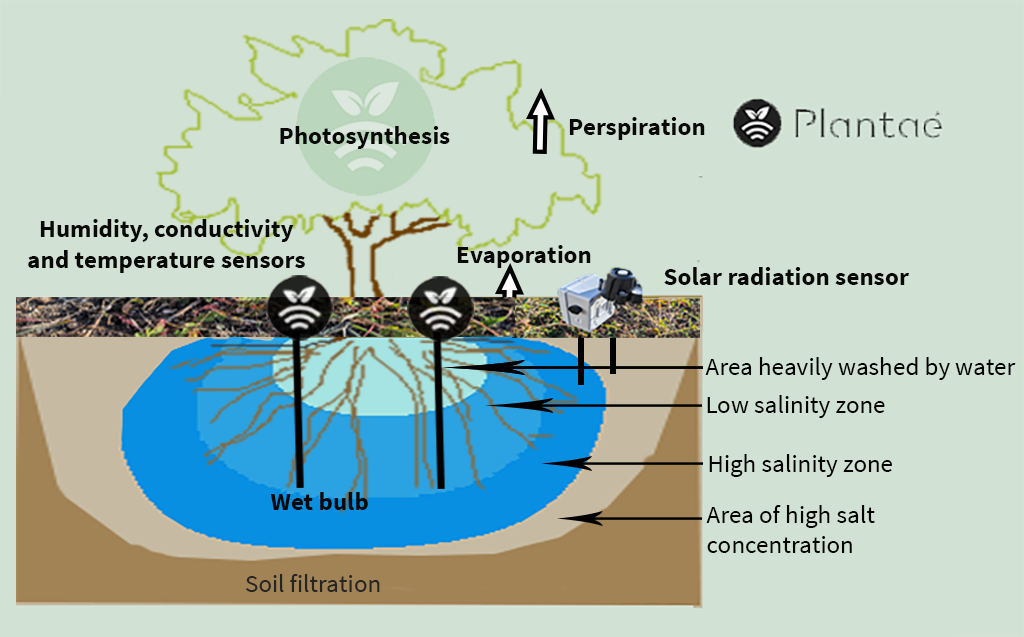
- Transpiration is the vaporization of liquid water from plant tissues and its subsequent release into the atmosphere through the stomata. Direct evaporation depends on solar radiation, air temperature, atmospheric humidity and wind.
- La evaporación es el proceso que transforma el agua líquida del suelo en vapor de agua.
- Evaporation is the process that transforms liquid water from the soil into water vapor.
To measure Evapotranspiration we need temperature and Solar Radiation data and we have different equations that can be used to calculate the reference evapotranspiration.
Our weather station, being modular, can install the sensors that are interesting for the client and depending on that choice, the HARGREAVES equation can be used or with a complete weather station we offer the calculation with the most used model, which is the Penman-Monteith.
Applications of solar radiation sensor
Greenhouse automation
- Using the solar radiation sensor measurements, decisions are made about opening and closing windows or awnings depending on the intensity of the radiation. With this value we can give indications about the possibility of covering the greenhouse, or recommend whitewashing it.
- Heating and ventilation systems are adjusted to maintain optimal conditions.
- Regulates artificial lighting in protected crops.
The solar radiation sensor in efficient irrigation management of crops
- Helps determine the best planting and harvesting dates based on available solar radiation.
- Relate solar radiation with evapotranspiration to calculate the water the plant needs.
- Sensors integrated into smart irrigation systems prevent water waste.
- Using solar radiation measurements, we estimate the nutrient demand.
- If we combine the solar radiation sensor with other humidity, conductivity and temperature sensors, the efficiency of fertilizer use improves.
- We identify water or nutritional deficiencies by analyzing changes in radiation absorption.
- Sensors are used in conjunction with satellite images or drones to detect problem areas in large areas of crops.
Sources
 English
  Spanish