
La importancia del riego optimizado adaptado a cada cultivo, lo explica el director del Departamento Agronómico, Emilio José Rodríguez Alises, en la jornada técnica: “difusión de acciones de demostración en proyectos de transferencia del conocimiento dentro de los objetivos PEPAC“.
How do we water?
The normal thing is to water as the neighbor waters, just like we plant the variety that is most commonly grown in the area. Nobody knows how much water their crop needs.
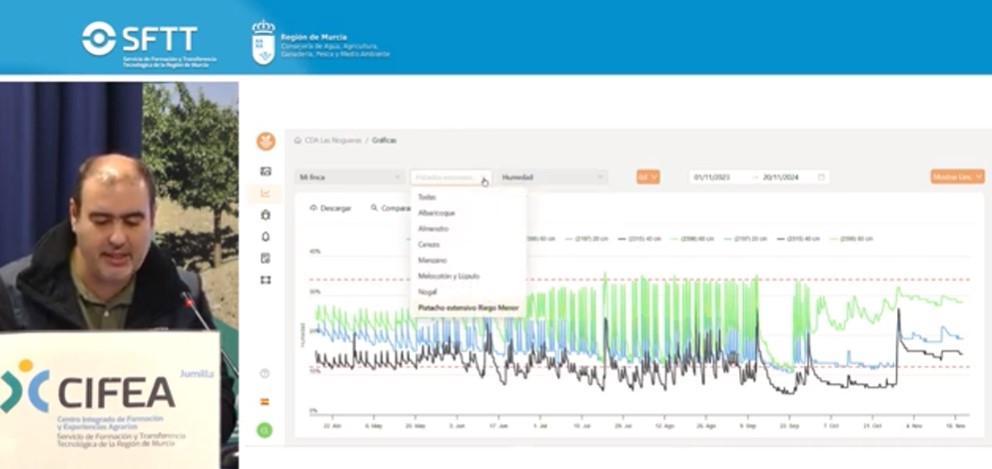
This is now possible with Plantae probes. It is not an expense, it is an investment, to be able to irrigate a larger amount of land. With the probes we know the depth of humidity, giving each crop what it needs.
It is about making good decisions, accompanying them with the interpretation of the graphs, advised by our technicians.
The graphs provide a profile of our soil.
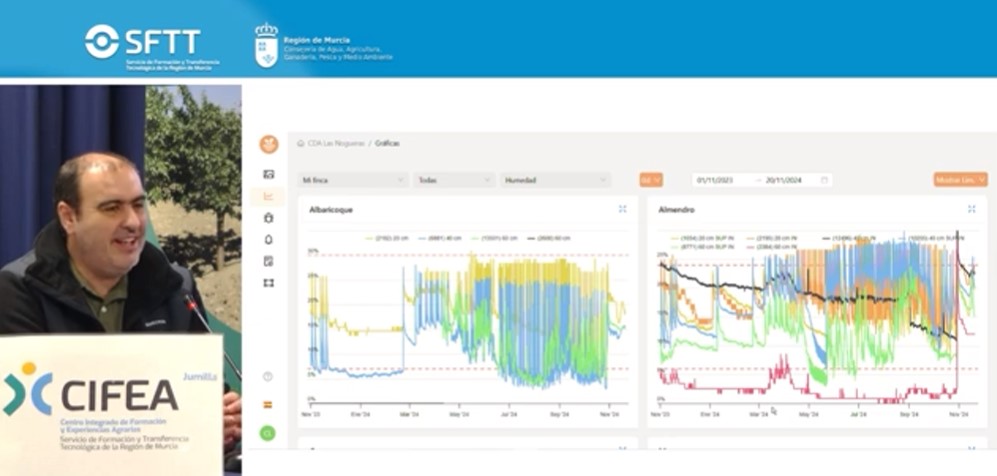
Optimized irrigation adapted to each crop
Controlled irrigation allows for better decision making, and installing probes is an investment that allows for improved operations. It improves profitability and boosts production.
Optimized irrigation means that more can be produced with less water.
It is essential to assess the type of irrigation that should be applied, design irrigation adapted to each crop and monitor it.
Agriculture has to become more and more technical, because we are competitive with other countries. Our problem is learning to manage water.
Data is useful to avoid wasting water. Optimizing water is essential; we must analyze the type of water; improper use of irrigation can cause a problem of salinity or the creation of fungi in the roots, waterlogging and a lack of oxygen that hinders plant absorption.
- Soil moisture sensors: Install humidity, conductivity and root temperature probes to measure when and how much to water. Our advisors help you interpret them so that decisions can be made tailored to each crop.
- Automation: Use flow meters and automatic systems to prevent overwatering or report potential breakdowns.
- Weather forecast: Adjust irrigation based on rainfall forecasts with the Plantae Weather Station.
Sources
 English
  Spanish