
Cotton moisture control is a crucial aspect to ensure optimal plant growth and quality fiber production. Proper irrigation, controlled by moisture sensors, helps maintain a constant supply of water in the soil, which is essential since cotton is a plant with a high water demand.
Water requirements:
Cotton requires a significant amount of water during its growing cycle. Water requirement varies depending on climatic conditions, stage of growth, and soil type, among other factors. It is important to consult local information or specific agronomic recommendations to determine the precise water requirements of the cotton variety being grown.
Soil monitoring for cotton moisture control
In cotton cultivation it is essential to ensure efficient irrigation management and guarantee adequate water supply to the plants.
Monitoring moisture content with probes adapted in depth to the wet bulb, allows determining when and how much water should be applied, avoiding both water stress and excess moisture.
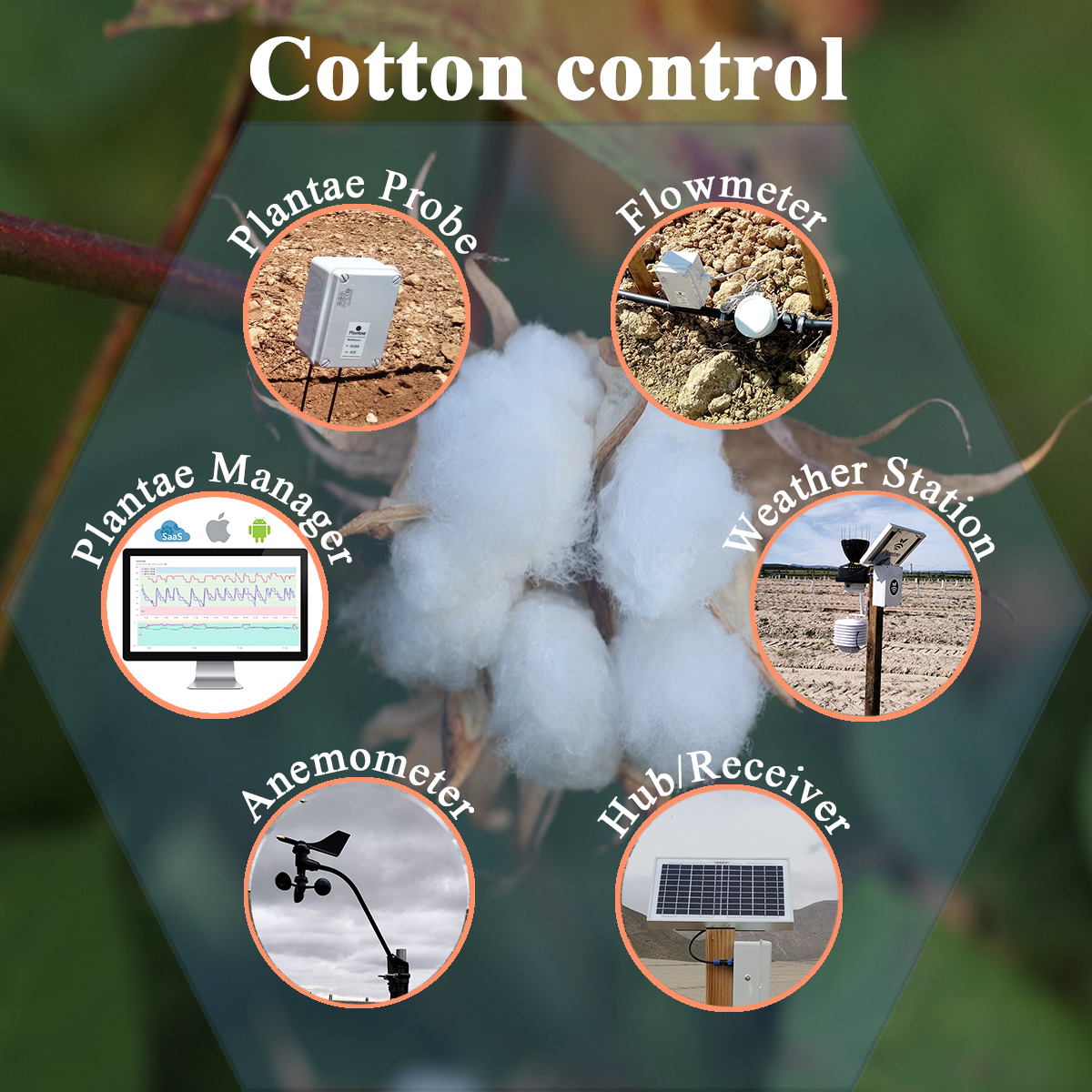
Plantae soil moisture meters, or moisture probes, are wireless and provide real-time readings. They are inserted into the soil to directly measure moisture at different depths.
These sensors provide instant readings and alerts on your tablet or mobile phone, and can help determine the need for irrigation.
The cotton plant needs a lot of humidity, because its leaves, with abundant stomata, transpire a lot in the heat.
Humidity control is necessary throughout the entire growing process. Given the amount of water needed, we can save up to 40% with the necessary input measured with sensors.
In addition, we can measure root temperature and ambient temperature. This helps to assess plant health and water loss through evaporation.
Another very useful measure is that of the wind, with a anemometer at the weather station we can monitor their activity.
It is also advisable to control the plantation with drones, if it is very extensive.
Application of sensors
- Location of measurements: Soil moisture content measurements should be made at different points in the field and at different depths to obtain a representative picture of soil moisture throughout the profile. It is recommended to take measurements in different areas of the field, considering the spatial need that may exist. In addition, it is important to take readings at different depths to assess the distribution of water in the soil profile.
- Monitoring frequency: The frequency of soil monitoring for various factors such as soil type, weather conditions, and plant growth status. In general, periodic measurements are recommended, at least once a week during critical crop stages such as flowering and boll formation. During less critical stages, monitoring frequency can be reduced.
- Interpretation of results: Interpretation of soil moisture data is crucial for making irrigation decisions. Target moisture thresholds must be set, taking into account soil characteristics and crop water needs. Irrigation is generally considered necessary when soil moisture reaches a certain predefined level. However, it is also important to consider other factors, such as climatic conditions and soil water holding capacity.
- Integration with other data: Soil monitoring should be complemented with other relevant data, such as reference evapotranspiration (ETo), precipitation and local weather conditions. Combining information on soil moisture, evaporation and precipitation can provide a more complete view of crop water needs and help determine the timing and amount of water to apply.
El monitoreo regular del crecimiento del contenido de humedad del suelo en el cultivo del algodón permite una gestión más precisa del riego, impidiendo el estrés hídrico o el exceso de agua.
We optimize the yield and quality of cotton fiber by providing an optimal growth environment for plants.
In this link counseling
Sources:
 English
  Spanish