
Kiwifruit in Spain is grown mainly in humid areas of the north, although there are also important plantations in the Mediterranean area with irrigation optimized by Plantae probes.
Kiwi in Spain
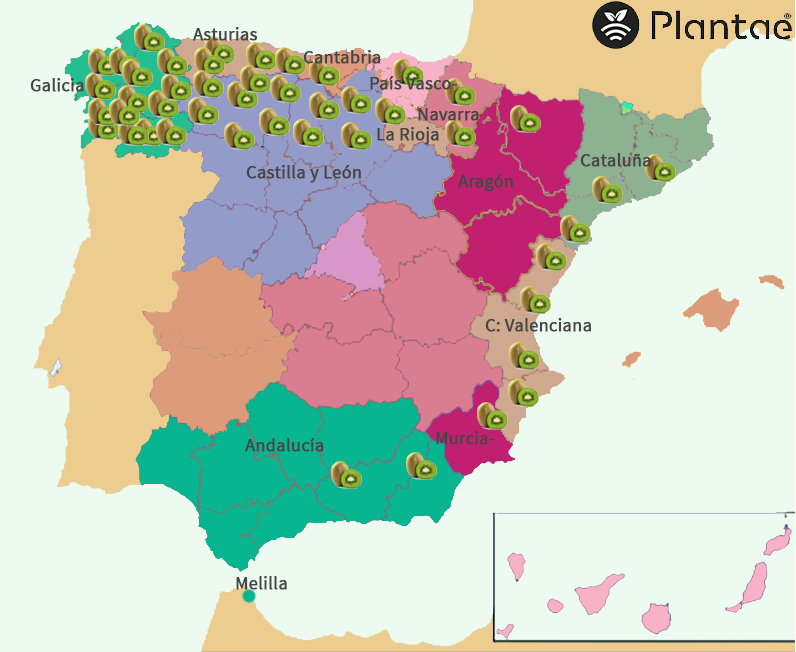
These regions are the most traditional and suitable for kiwi cultivation in Spain:
- Galicia, the main producing area, especially in Pontevedra, which is where the largest volume is produced and where there is greater technical experience.
- Asturias, Cantabria, Basque Country and Navarra, also with significant plantations.
- Valencian Community, there are initiatives to expand the crop, most of which require controlled irrigation.
- Catalonia, Murcia and some areas of Andalusia, smaller but present plantations.
- Northern Castile and León, northern Aragon, it is being cultivated in temperate zones.
In the northern region, green kiwifruit (Actinidia deliciosa) is widely cultivated, being very productive, with the Hayward variety being particularly common in Pontevedra. Other varieties include Bruno, which is earlier maturing and more vigorous, and Monty, which is productive but somewhat less commercially viable.
In the Mediterranean, the yellow kiwi (Actinidia chinensis) is more widely cultivated because it is more sensitive to frost. Soreli adapts well to sensor-controlled irrigation, while Jintao is more productive but susceptible to water stress. The green kiwi (Boerica) is also grown, and it is more tolerant than the variety cultivated in the northern region.
Suitable climate
The northern areas share a temperate climate, with high ambient humidity, regular rainfall and mild temperatures, with a lower risk of late frosts that destroy flowers in spring.
The Mediterranean zone requires additional measures, such as partial shade or greater irrigation control, because temperatures can be higher and humidity lower than optimal for kiwifruit.
Kiwifruit prefers optimal temperatures between 12 °C and 29 °C during the growing season.
Spring frosts can destroy flowers and reduce production, even if the plant tolerates frosts better in mid-winter.
Excessive heat (above ~35 °C) can cause damage to leaves and fruit.
Plantae sensor-optimized irrigation
Since kiwifruit consumes a lot of water and is sensitive to both excess and lack of it, controlling irrigation with soil moisture sensors and automatic systems can make a big difference:
✅ Why is sensor-controlled irrigation useful
- It allows you to apply water just when the plants need it, without wasting resources.
- Avoid water stress from drought and waterlogging, which can cause root diseases.
- It improves irrigation efficiency, especially in areas where the climate is less humid or more irregular.
📊 How it works
A typical system includes:
- Soil moisture sensors (to measure the actual water content in the soil and conductivity).
- Soil temperature sensors, especially useful for checking the health of the root system.
- strong>Weather stations or environmental sensors (temperature, wind speed, rainfall, hours of cold, relative humidity…).
- An IoT controller or system that activates irrigation only when sensors indicate that the soil is below a set threshold.
- Monitoring and automation with a digital platform.
📈 Real example in Spain
A major operator in Galicia (Kiwi Atlántico) is implementing sensors and intelligent systems to:
- Monitor soil moisture levels and weather conditions.
- Manage irrigation accurately and efficiently.
- Detect plant stress or conditions that may damage production.
Optimization success story in Picassent, Valencia
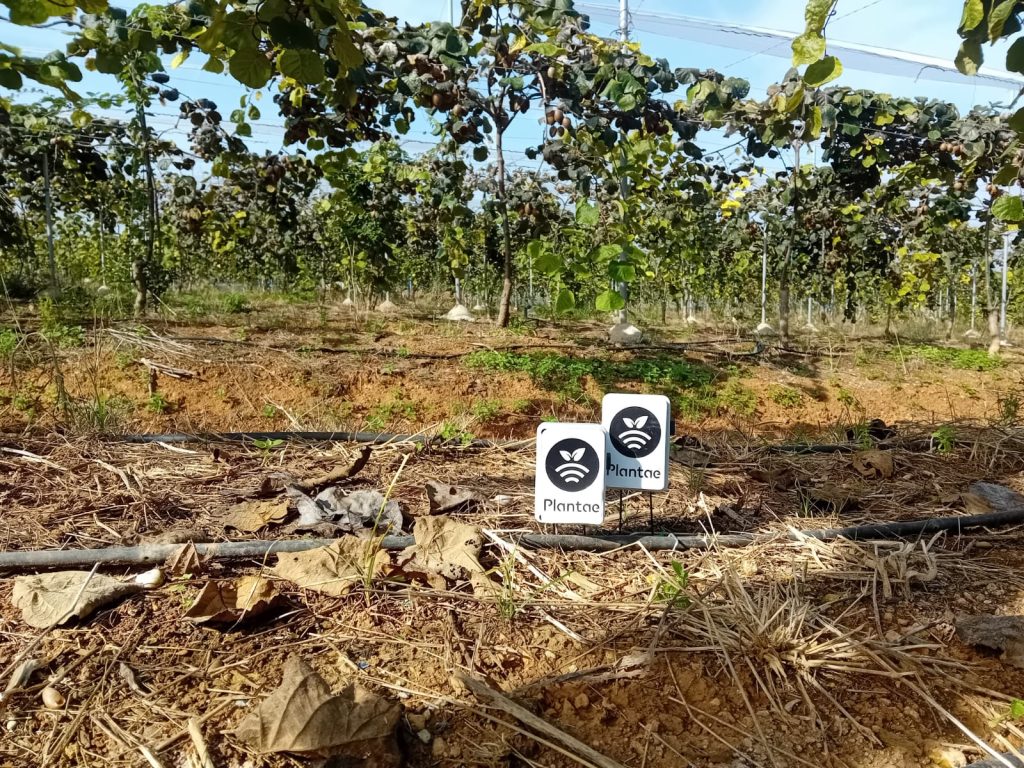
This intensive kiwi plantation incorporates drip irrigation and humidity and conductivity sensors at different depths.
Irrigation control with probes achieves optimized irrigation and significant water savings, as well as preventing water stress in the crop.
The crop is also protected with netting to prevent excessive heat and reduce evapotranspiration.
Sources:
 English
  Spanish