
Knowing how much water the soil can hold is the foundation of good irrigation. First, we measure it by weight (gravimetric) and then we transfer it to the field (volumetric). Emilio Rodríguez, Director of the Agronomy Department at Plantae, explains.
Gravimetric measurement
- It is based on mass.
- You measure how much something weighs.
- In chemistry and soil analysis, for example, you can measure how much water is in a soil sample by weighing it before and after drying. Wikipedia
👉 Typical result: gravimetric moisture content = mass of water / mass of dry soil.
Volumetric measurement
- It is based on volume.
- Instead of weighing, it is measured or expressed by volume.
- For example, the volumetric moisture content of soil tells you how much water is present per unit volume of total soil (not per mass). Wikipedia
👉 Typical result: volumetric moisture content = volume of water / total soil volume.
How do you go from gravimetric → volumetric?
To make the conversion you need to know the density of the soil or its apparent density.
General formula
Yeah
- θg = gravimetric water content (kg/kg)
- ρb = apparent density of soil (kg/m³)
- ρw = density of water (approx. 1000 kg/m³)
Then:
👉 This gives the volumetric water content ().
In other words: you take the weight of water per mass of soil and convert it to the volume of water per volume of soil using densities. (This is the most standard and commonly used method in agronomy/soil science.)
This type of conversion is what is normally done in soil moisture studies when you have gravimetric (mass) data and you want it in volumetric terms (for models or sensors).
Why is this conversion being done?
✔ In analytical chemistry (general):
- The gravimetric method is very accurate because it only uses mass.
- The volumetric method is faster for titrations where you already know the reactions and can use a volume of titrant.
✔ In soils / agriculture / environment:
- Sensors and models usually work with volume of water per volume of soil (volumetric), because this relates better to the actual availability of water for plants.
- Gravimetric measurements are used to calibrate volumetric sensors (e.g., TDR or capacitive sensors).
📌 A practical example explained by the director of agronomy at Plantae
How much water can the soil hold?
We are going to explain the concept of how much water a soil is capable of retaining, a very common question when we make field visits.
Knowing this information is key because, based on it, we can calculate what the irrigation dose should be, which is technically known as irrigation depth.
To perform this calculation, at Plantaec we work with gravimetric units, that is, units related to the weight of the soil.
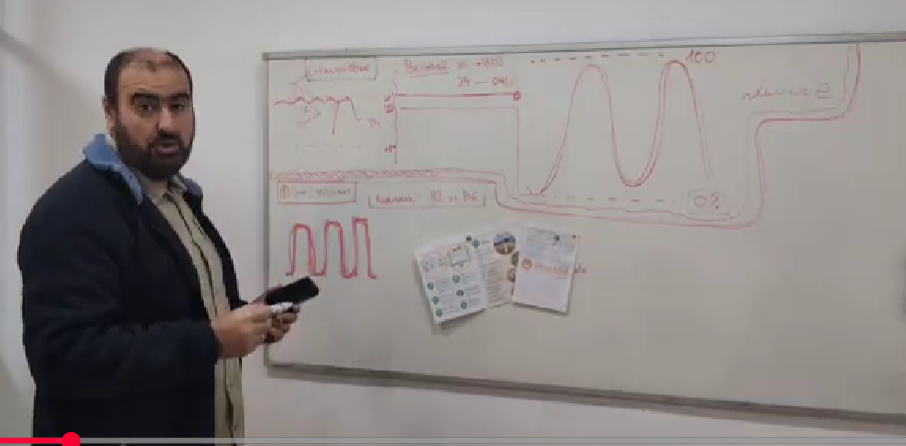
Methodology for calculating water retention capacity:
- Sample collection
A soil sample is taken in the field, always weighing more than 1 kg - Soil Drying
The sample is placed in an oven until all the water is removed. This gives us soil with 0% moisture.
In the example, the dry soil weighs 1 kg. - Water saturation
A large amount of water (1–2 liters) is added to that kilogram of dry soil and placed in a container that allows drainage of excess water. - Drainage
It is left to drain for approximately 12 hours, so that only the water that the soil is able to retain remains. - Final weighing
After drainage, the sample is weighed again.
In this example, the final weight is 1,300 kg.
👉 Conclusion:
The soil has retained 300 ml of water, which is equivalent to 30% of its weight.
That is the key fact: this soil can hold 30% water.
Weight to volume conversion
Now we transfer this data to the field:
- Considered surface: 1 m²
- Soil depth: 50 cm (0.5 m), (It is not normally done at greater depths in many soils in Spain)
The volume of soil is: 1 m² × 0.5 m = 0.5 m³
If we know that the apparent density of the soil is, for example: 1,400 kg/m³. Then in 0.5 m³ we have: 700 kg of soil
Calculation of total stored water
If the soil can retain 30% water: 700 kg × 0.30 = 210 liters of water
👉 This means that, to completely fill the first 50 cm of soil in 1 m² with usable water, we need 210 liters of water.
Water available to the plant
Not all the water retained by the soil is available for cultivation. This is where concepts such as the following come into play:
- Total available water.
- Easily assimilated water.
For example, if we consider that the crop can comfortably extract water until the humidity drops from 30% to 15%, that 15% would be the actual usable water.
However, in sensitive crops (especially horticultural crops), farmers usually avoid any type of water stress. Therefore, in practice, they don't work with the full range of available water, but rather with a permissible level of depletion.
Example of practical handling
Let's assume that:
- Maximum soil capacity: 30 %.
- Minimum allowed level: 24 %.
This means that we only allow 6% of the water to be extracted.
To facilitate interpretation, we transformed the scale:
- 30% → 100% of the “deposit”.
- 24% → 0% of the “deposit”.
It does not mean that the soil is dry, but rather that this is the management range that interests us.
If 100% is equal to 210 liters, then: 6% = 12.6 liters per m².
Practical applications
With this information we can:
- Calculate the irrigation duration.
- Decide if the installed drippers are adequate.
- Adjust the irrigation frequency.
- Correctly interpret the soil moisture graphs.
It all starts with understanding how much water the soil can hold and what extraction margin we are willing to allow depending on the crop and agronomic management.
 English
  Spanish