
On March 31, 1979, the first waters of the Tajo-Segura transfer arrived, currently regulated by the Ley 21/2013With them we irrigate the provinces of Murcia, Alicante and Almería.
Tagus-Segura transfer
The purpose of the transfer is to promote irrigated areas in an area where the number of hours of sun and the little difference in daytime and night temperatures, in addition to the absence of frost, makes it become an engine of agriculture.
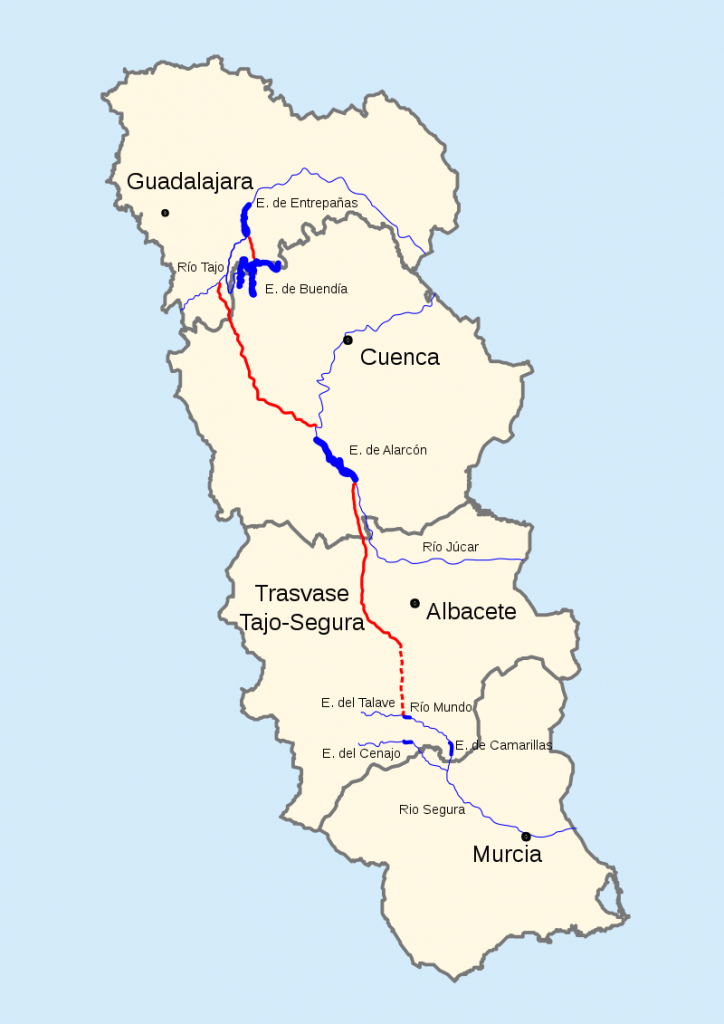
The water comes from the Entre-peñas and Buendía reservoirs, in Castilla la Mancha. The canal consists of 292 kilometers in the open sky.
It crosses the provinces of Cuenca and Albacete, until it reaches the Segura River.
Desde Azud de Ojós (Murcia) en 1978, se inicia el Postrasvase y el agua se distribuye a las tres provincias de Murcia, Alicante y Almería, dando servicio de regadío a unas 55.000 hectáreas. “El 40% para la provincia de Murcia, el 30% para la provincia de Alicante y el 30% para la provincia de Almería, según recoge la Ley de Régimen Económico de la Explotación del Acueducto Tajo-Segura (1980)”(Region of Murcia digital).
La posibilidad de regar una zona privilegiada por su clima, hizo que se convirtiese en la principal productora de hortalizas, conocida como la “huerta de Europa”.
Sustainable waters
Since 1995, the basic principles of a sustainable water policy have been created throughout the European Union. it establishes that water is a social good that must have regulated rates. The final text was published in the year 2000 and includes the following points:
a) Prevent any further deterioration and protect and improve the state of aquatic ecosystems and, with respect to their water needs, of terrestrial and wetland ecosystems directly dependent on aquatic ecosystems.
researchgate.net
b) Promote sustainable use based on long-term protection of available water resources.
c) Guarantee a sufficient supply of surface or underground water in good condition, as required by a sustainable, balanced and equitable use of water.
d) Increase the protection and improvement of the aquatic environment, among other ways, with specific measures for the progressive reduction of discharges, emissions and losses of priority substances, as well as through the interruption or gradual suppression of discharges, emissions and losses of priority hazardous substances. Although it is an objective referring to the quality of the water, this must necessarily be linked to the quantity, for which reason quantitative measures must be established subordinated to the objective of guaranteeing good quality.
e) Guarantee the progressive reduction of groundwater contamination and avoid new contamination.
f) Contribute to alleviate the effects of floods and droughts. Member States have two years from the entry into force of this Directive to approve the legal, regulatory and administrative provisions necessary to enforce its provisions (art. 24.1).
Mediterranean irrigation communities
Managing the distribution of water throughout the Mediterranean basin is something that has been done since the 9th century.
The irrigation communities are recognized by the Spanish legal system as customary and traditional courts. They are democratically elected by the communities.
Their functions are:
- Cohesion of the irrigation communities.
- They control the concordance of guards, inspectors, pruners, etc.
- They transmit orally their knowledge obtained from other generations.
- They base their training on knowledge of irrigation technology and act as a commonwealth.
Sources:
 English
  Spanish