
We are going to try to explain in a simple and graphic way what the golden number and the Fibonacci series are , how they are calculated and how they appear in nature.
Obtaining the golden number or divine proportion
The golden number is the ratio of the sides of a rectangle that is built from a square.
The golden rectangle has fixed proportions that correspond to the number Phi = 1,618 ... real number of infinite decimal places without periodicity.
- We build a square and draw a line from the middle of the base to a vertex.
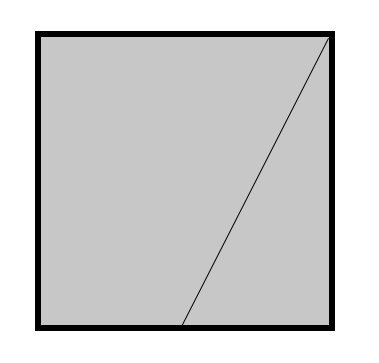
- We break down this line by drawing an arc. With that measure we make a rectangle.
- We already have a golden rectangle.
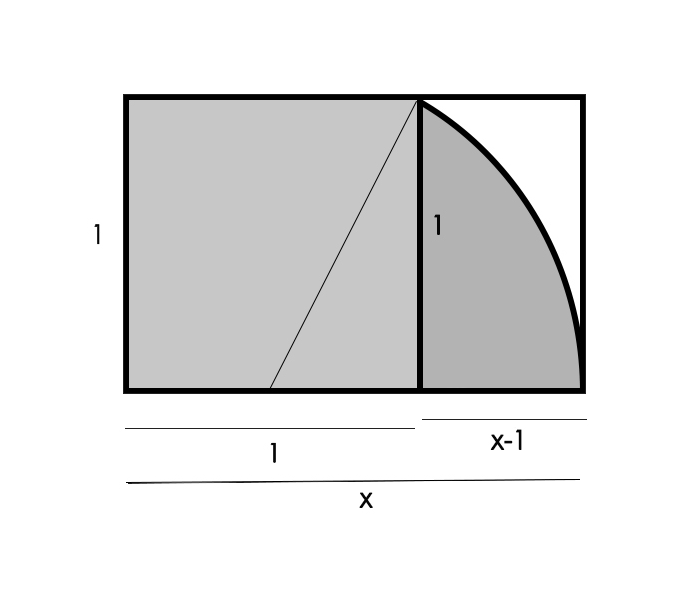
Calculation of the golden number
- Vamos a suponer que el lado del cuadrado mide un metro. Si la base del rectángulo es “x”, obtenemos la siguiente proporción:
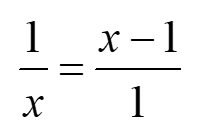
- The two sides of the outer rectangle are in proportion to the smaller rectangle. With this proportion and solving the equation, the golden number results.
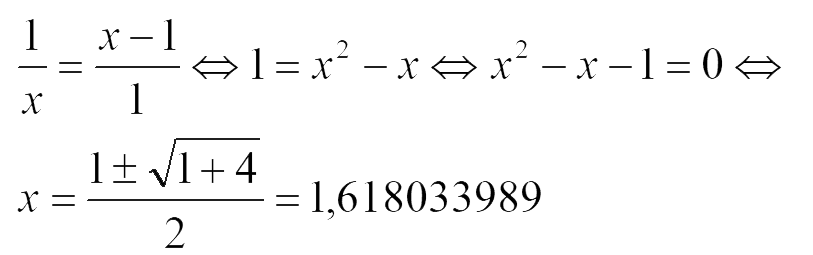
The proportion between the longest and shortest sides [x/1] of the rectangle is the golden ratio= phi=φ= 1.618…..
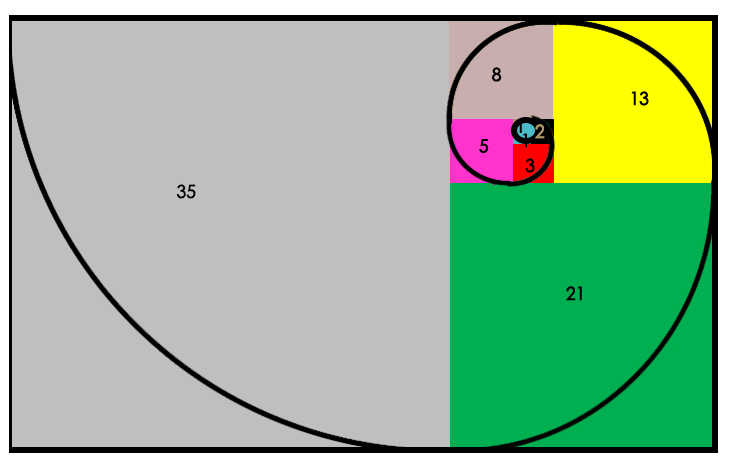
- If we continue making rectangles with this process, they continue to maintain the proportion.
- If we make a large number of smaller and smaller rectangles, we arrive at that the measures of the square and the rectangle tend to equal, then we assume the value of one unit and a relationship appears between the measures of the rectangles and the growth of the series of Fibonacci as we can see in the following figure. 1, 1, 2, 3, 5, 8, 13, 21, 35, 56,…..
This rectangle is part of our daily life such as the proportions of the computer screen, the measurements of ID or credit cards, in works of art, in the proportions of the human body ... etc.
It is proven that visually it is more pleasing to the eye.
Archimedean spiral and its relationship with the golden number
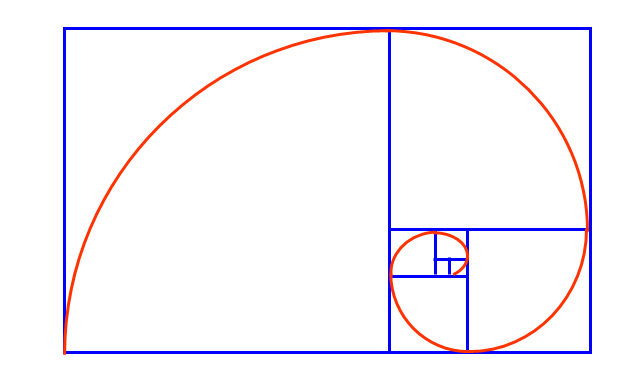
If we draw arcs of circumference with the measure of the radius equal to the side of each square , we obtain the following curve:
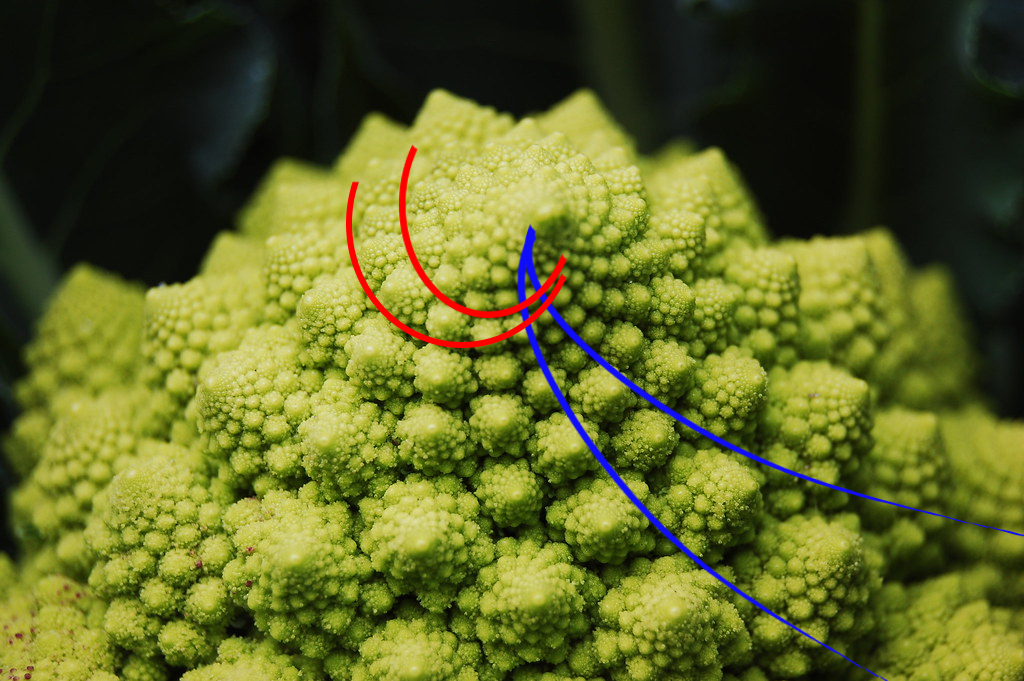
This spiral is found in nature, for example in Romanesque, in sunflower seeds, in pineapples….
We observe that the number of spirals that form to the right and to the left are correlative numbers of the Fibonacci series. If to the left in red there are 21 then to the right in blue there are 34, and 34/21 = 1,618 ...
Fibonacci series in plants
In the year 1202 Fibonacci discovers a series of numbers that appear in nature.
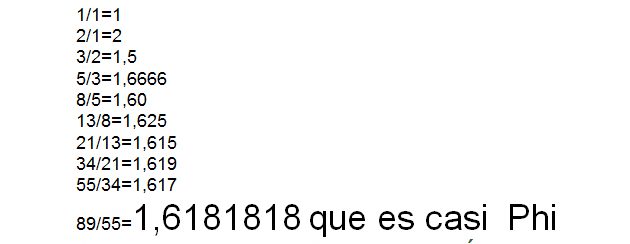
La serie es: ” 1, 1, 2, 3, 5, 8, 13, 21, 34, 55, 89…..” Si observamos cada número es la suma de los dos anteriores, por tanto el número siguiente de la serie sería 144.
If we divide each number by the previous one, we obtain that it tends to the golden number:
This series appears in the reproduction of rabbits and cows but we focus on the growth of plants.
Golden angle value
We already observed in an article that the flower of the artichoke it follows a golden ratio in such a way that two leaves never overlap and thus all receive sunlight.
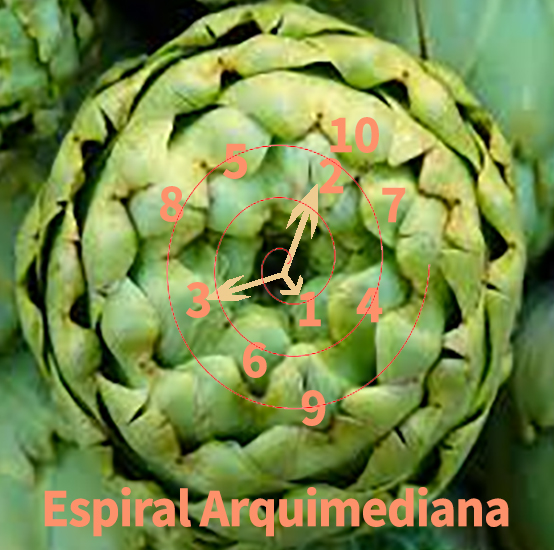
This is because they grow with a golden angle that is obtained by forming a circle with:
- Measure from the longest side plus the smallest side of the rectangle.
- We measure the arc corresponding to the short side.
- We obtain that said arc corresponds to the angle of 137.5º.
The Fibonacci series also leads to the golden angle.
The ratio of each quotient in the series of 360 degrees = golden angle = 137.5 degrees, with more accuracy the further you advance in the series.
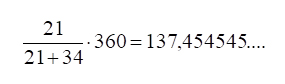
That is to say:
This angle and therefore the Fibonacci numbers and the golden number are related.
We can see how the appearance of the branches of a tree seen from above have approximately this angle two consecutive branches.
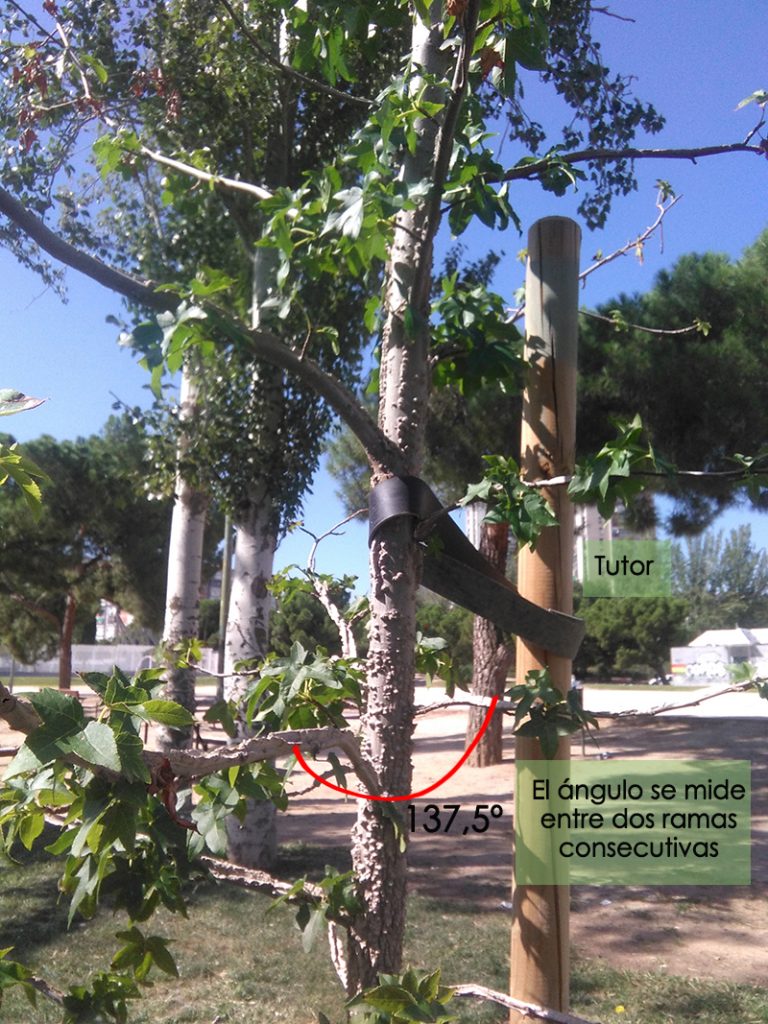
It is also fulfilled in:
- The distribution of the leaves on the plant.
- The distribution of the branches in the tree.
- The ratio between the main and secondary branches.
In some flowers and fruits they are observed in a very significant way as in:
- The pine cones of the fir trees.
- The tropical pineapple.
- The Palm trees.
- The flower of the artichoke.
- The romanesco.
- Sunflower.
- The daisy.
- Cauliflower.
- The cica.
- The Rose.
- Thorns on the stem of roses.
- Many others.
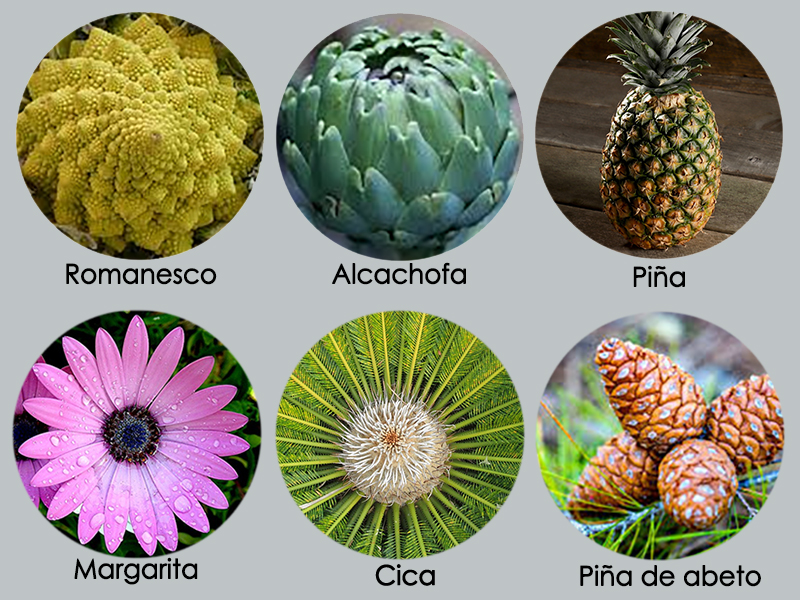
All symmetries of one form or another grow in the golden ratio, in angle or Fibonacci number.
Golden angle of rose flower growth
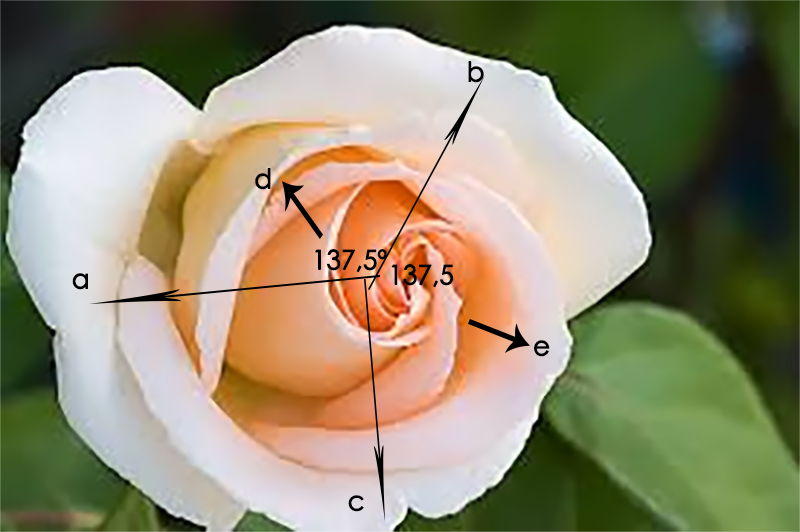
In the case of the rose, we measure the angles of the consecutive petals that we observe from highest to lowest.
Nunca vamos a encontrar dos pétalos superpuestos, por la propiedad de crecer con este ángulo de 137,5 grados como vemos entre el punto “a” y el “b”, entre el “b” y el “c” y así sucesivamente.
This angle means that no matter how many petals grow, two will not coincide in the same direction.
Not all plants grow in this order, there are always alterations but it has been proven that where symmetry and beauty are, there is the golden number .
How this relationship between the golden number and plants occurs
All this, how does it happen?
We have all observed the harmony of certain plants, the symmetry of some fruits, and the beauty of flowers.
Esta disposición no es casual, sigue un orden llamado filotaxis de la composición de dos palabras “filo=hoja” y “taxis=orden”.
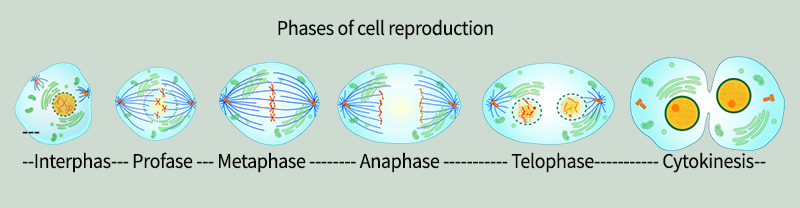
Los responsables de este orden son los “meristemos”, formados por células madre con forma poliédrica que se reproducen constantemente con el proceso llamado mitosis y que consta de seis fases.
This reproduction in general is spiral in shape. The curvature matches that of Archimedes. In other words, the angle of rotation is the golden one and in each rotation a new cell appears.
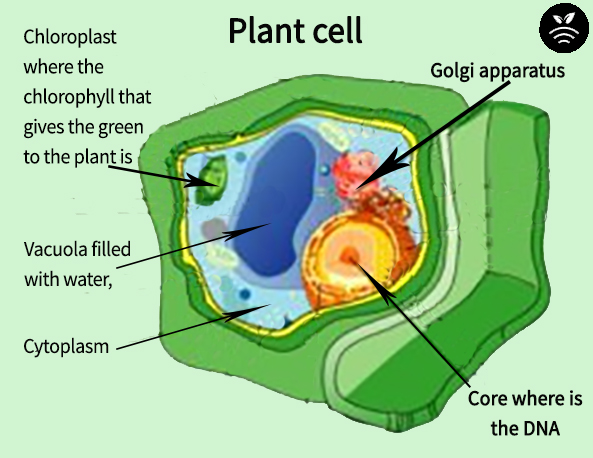
Its growth and multiplication are influenced by the water that enters its vacuoles, an important part of the cell where it is stored together with salts and sugars.
It is for this reason that water control is essential for the proper development of the plant. If the plant suffers water stress, this reproduction is altered.
These meristems can be permanent such as those on the branches or temporary such as those that give rise to flowers.
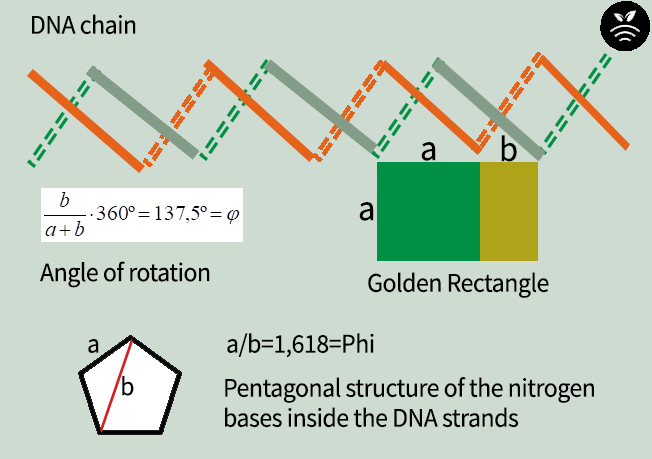
These cells are like the information code, constituting the DNA of plants . These chains follow spirals with golden turns and inside are nitrogenous bases with pentagonal
The diagonal of the pentagon divided by the side is the golden number.
Each leaf, petal or branch generated by the cells in their reproduction will appear ordered, favoring a natural balance that makes two leaves not overlap, neither two branches nor two petals.
Influence of the golden number on the development of plants
This influences:
- The runoff of rainwater on the plants so that it reaches the roots better.
- Also in that all the leaves can better receive sunlight.
- Pollination is favored with this spectacular distribution.
In other words, the golden structure makes the plant grow in harmony, we only have to provide it with water in a constant and controlled way as well as adequate temperature and nutrients so that its regeneration is not altered, then its development and beauty will be around perfection.
Poetry by Rafael Alberti, written in 1946 to the golden number considered as the Divine proportion
"TO THE DIVINE PROPORTION"
To you, wonderful discipline,
average, extreme reason for beauty,
who clearly abides by the closure live in the mesh of your divine law.
To you, happy prison of the retina,
golden section, celestial square,
mysterious source of measure that the harmonic Universe originates. To you, sea of angular dreams, flower of the five regular forms, blue dodecahedron, sound arc. Lights by wings a fiery compass. Your song is a transparent sphere.
To you, divine proportion of gold.
Sources
 English
  Spanish