
The monitoring of manure and biogas by temperature sensors is an advanced technology used in agriculture and livestock farming to manage animal manure more efficiently and reduce its environmental impact.
This modern system uses a variety of sensors and devices to monitor the quantity, composition and distribution of manure, allowing farmers and ranchers to make decisions about its management.
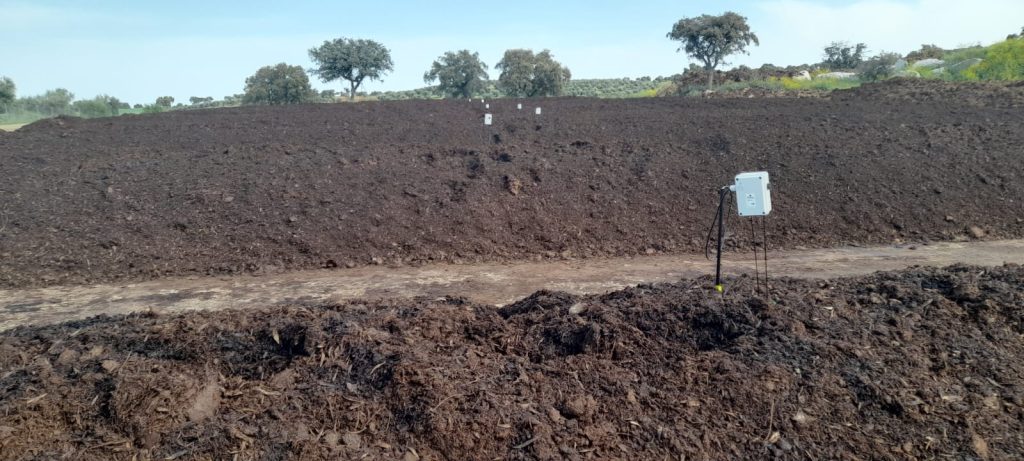
Temperature sensors for measuring manure composition
When we measure the temperature of manure with sensors, we optimize the biological and chemical process that affects its decomposition, influencing its quality as a fertilizer.
Temperature is a measure of microbial activity, and an increase in temperature is indicative of effective decomposition.
We have three phases:
- Mesophilic with temperatures between 20 and 40°C. Simple materials decompose.
- Thermophilic with temperatures between 40 and 70°C. More resistant materials are broken down and pathogens such as bacteria, protozoa, fungi, viruses, viroids and prions are eliminated.
- Cooling and Maturation: The drop in temperature indicates that the decomposition process is stabilizing, and the compost is maturing.
Temperature measurement ensures a high-quality composting process. (+Information about compost)
Difference between compost and biogas
Both are obtained from the decomposition of manure or organic matter, but with different processes.
- Compost is produced through contact with oxygen, generating heat and carbon dioxide.
- Biogas is produced from manure or organic matter in the absence of oxygen, in a closed environment and with temperature control. Methane and carbon dioxide, renewable energy sources, are preferably obtained.
Compost is mainly used to enrich and improve soil quality, biogas is produced to generate energy.
Advantages of using temperature sensors
Temperature control with sensors is essential to optimize manure management, ensuring that it decomposes properly and minimizing its environmental impact.
In the case of biogas, control is essential. Sensors ensure that optimal conditions for anaerobic fermentation are maintained, maximizing biogas production and minimizing the production of unwanted by-products.
Temperature sensors allow farmers and ranchers to monitor this process in real time, ensuring that manure is decomposing effectively.
In large piles of manure or compost, temperatures can rise to dangerous levels, which could result in spontaneous combustion. Temperature sensors help detect these elevations in time to take preventive measures, such as turning the compost or adding water.
In the composting process, maintaining an adequate temperature is crucial for the destruction of pathogens and weed seeds, as well as for accelerating the decomposition of organic material. Sensors allow precise control, ensuring efficient and high-quality composting.
Data collected by temperature sensors can be integrated into broader management systems that automatically control other aspects of manure management, such as aeration, moisture and amendment addition.
Temperature control ensures that the decomposition and fermentation processes are efficient, which can result in better quality compost or increased biogas production.
By preventing dangerous temperatures, the risk of fires in manure piles is minimized.
Proper temperature management helps reduce greenhouse gas emissions, contributing to a more sustainable operation.
If you want to know more about temperature sensors for manure click here.
Sources:
 English
  Spanish