
Intensive almond cultivation is negatively affected by salinity, among other reasons because it requires more irrigation water, as there are more trees per square meter. These effects are not the same for all varieties. We analyze this in the following article and seek solutions using probes.
General impact of salinity on almond trees
The effects can be of several types:
- Direct ionic toxicity: The absorption of high concentrations of sodium (Na⁺), and chlorine (Cl⁻) damages plant cells, especially in young leaves.
- Osmotic stress: The accumulation of salinity in the root system makes it difficult for the plant to absorb water, as if it were in a drought.
- Nutritional imbalance: An imbalance occurs that interferes with the absorption of essential nutrients such as potassium, calcium and magnesium.
Plantae conductivity probes
Essential for salinity control in intensive almond plantations:
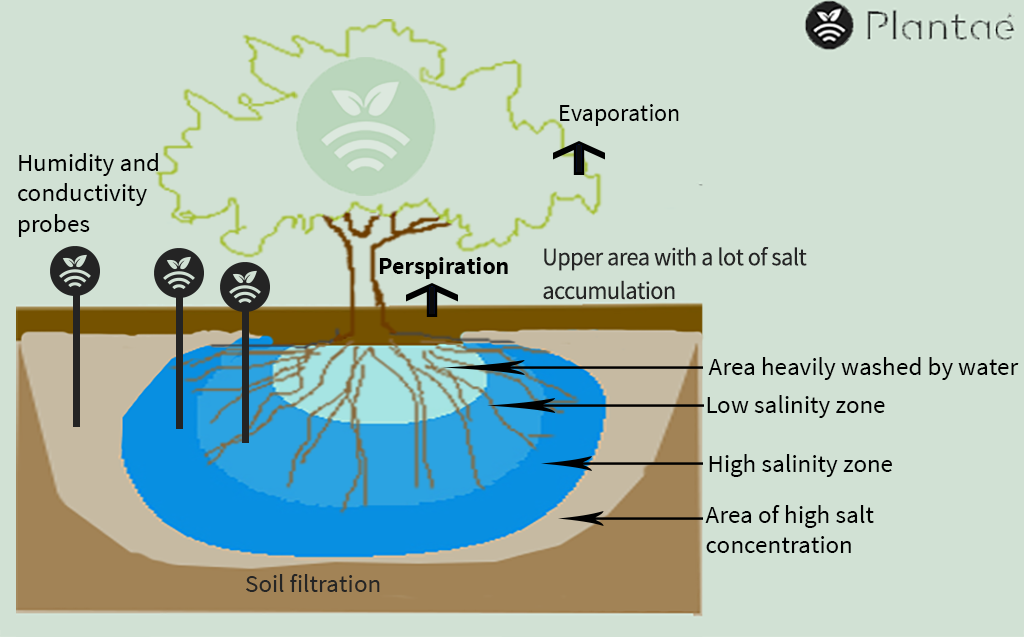
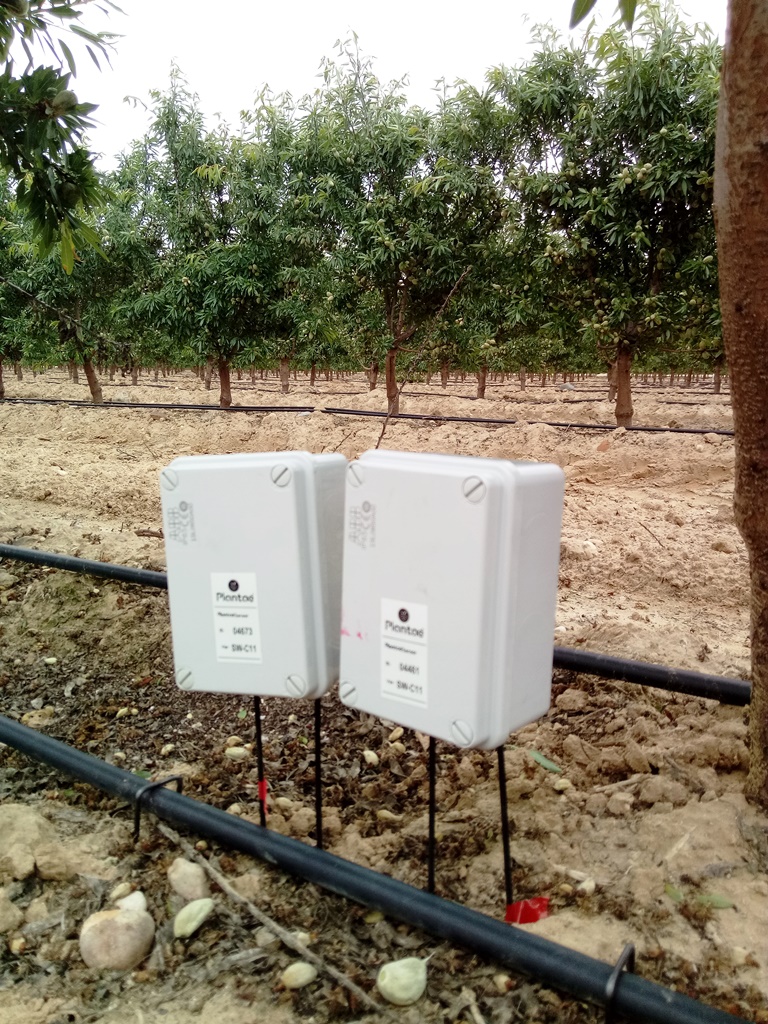
- The probes allow measuring the soil conductivity at different depths (15, 30, 60, 90 cm), in real time, and help to see where the salts are accumulating.
- They allow irrigation to be optimized, adjusting volumes and frequency, applying scheduled washes when excessive salinity is detected.
- Controlan que la zona radicular esté activa y no supere los umbrales críticos (entre 2.5 y 3 dS/m según variedad y portainjerto). (dS/m, “deciSiemens por metro” es una unidad de medida de la conductividad eléctrica).
- Nitrogen and potassium (N, K) fertilizers often also provide salts; probes help adjust dosages and prevent buildup.
- With continuous conductivity data, you can decide whether a variety or rootstock responds well to the saline environment or whether irrigation management needs to be changed.
Salinity tolerance according to the almond variety
| Variety | Salinity tolerance | Comments |
|---|
| Guara | Low | Very productive but sensitive to sodium chloride. Avoid in saline soils. Generally shows effective tolerance mechanisms. |
| Lauranne | Low | Good adaptation to intensive farming, but not very tolerant to saline soils. |
| Ferragnès | Low to medium. Not recommended for intensive plantations. | It produces well, large almonds, hard shell, highly valued commercially but can show symptoms of toxicity in leaves with salts. |
| Marcona | Medium. Not recommended for intensive plantations. | Tradicional, algo más rústica y con mayor tolerancia relativa. Excelente The almendra de referencia gourmet en España. |
| Soleta | Medium-high | An almond variety with the best tolerance among modern varieties; suitable for irrigation with harder water. |
| Penta | Medium-high | Almond variety that adapts moderately well to salinity if a good rootstock is used. |
| Vairo | Medium | Almond variety that adapts well to intensive cultivation; somewhat better at handling salinity than Lauranne. |
| Avijor | Medium-low | Almond variety sensitive to salinity in intensive plantations. |
| Vialfas | Medium-low | Almond variety sensitive to salinity in intensive plantations. |
| Prunus dulcis | Medium | Significant variability in tolerance as almond rootstocks. |
Study on the “Evaluation of the salinity tolerance of four self-rooted almond genotypes in intensive plantations” (Source Interempresas.net)
This study evaluated the salinity tolerance of four self-rooted almond genotypes under intensive planting conditions. It focused on analyzing how salinity affects the growth and development of these genotypes.
- Significant differences were observed in salinity tolerance between the genotypes evaluated.
- Salinity negatively affected the growth and development of almond trees, with variations depending on the genotype.
- The importance of choosing genotypes with greater tolerance to salinity is crucial for the success of intensive plantations in saline soils.
- It is essential to implement appropriate management practices to mitigate the negative effects of salinity on almond trees.
The study provides valuable information for farmers and technicians working with almond trees under saline conditions, highlighting the importance of selecting appropriate genotypes and implementing effective management practices. (+ INFO in Interempresas.net).
Sources
 English
  Spanish