
We installed probes in a tomato greenhouse in Badajoz to assess the evolution of humidity during the hottest months.
Optimizing irrigation with probes in a tomato greenhouse in Badajoz
We analyze the behavior of the humidity graphs during the most demanding months for tomatoes in Spain.
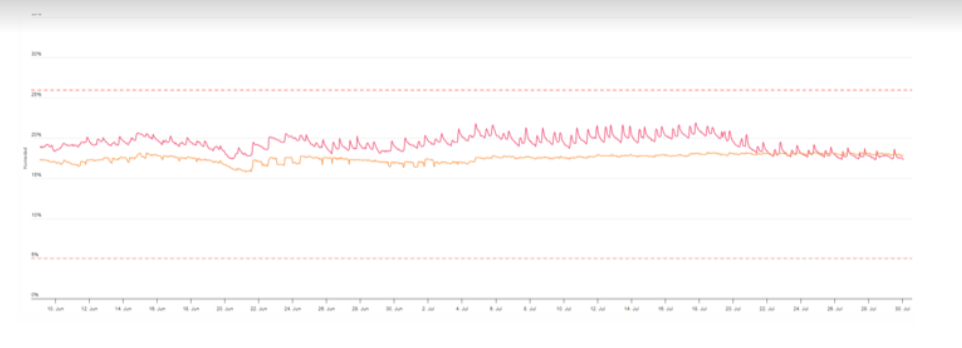
In this image we can see how the farmer, thanks to irrigation, manages to maintain the humidity at 70-80% of the field's capacity, ideal for the correct development of the crop. In addition, the 30 cm sensor does not show large elevations, which allows us to know that the humidity and nutrients have been deposited in the area of maximum root activity. The 15 cm sensor is the one that draws the irrigation and the extraction of the plant.
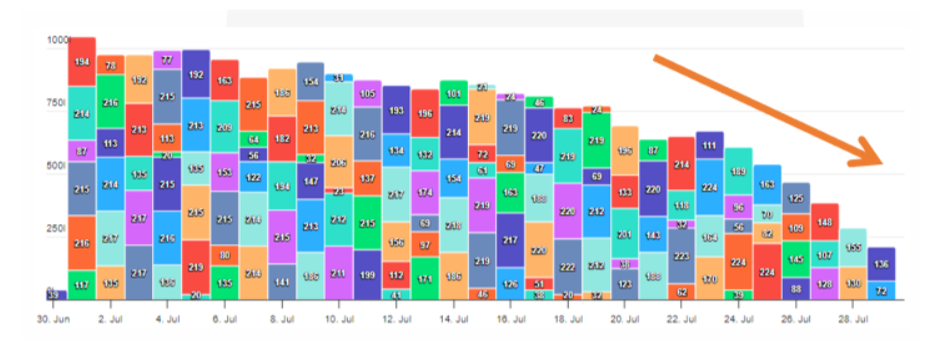
Analyzing the irrigation dose used by the farmer. We can see how the trend of water use is downwards, so with fewer resources we achieve the objective throughout the crop cycle, as we saw in the previous slide.
We must bear in mind that efficient use of water not only translates into water savings, but also into savings on inputs (fertilizers, phytosanitary products, etc.) since the health of the crops also improves with efficient irrigation.
Importance of probe control in tomato cultivation
The probes measure the water content in the soil, helping to ensure that plants receive the right amount of water without excess or deficit. In dry climates, monitoring soil moisture is crucial to avoid water stress and maintain efficient irrigation, as the graphs above show.
The farmer experiences considerable savings in water and energy, but the tomato crop also gains in quality and flavour, because the nutrients reach the plant in an optimal manner.
Do not hesitate to consult our technical team
Sources:
 English
  Spanish