
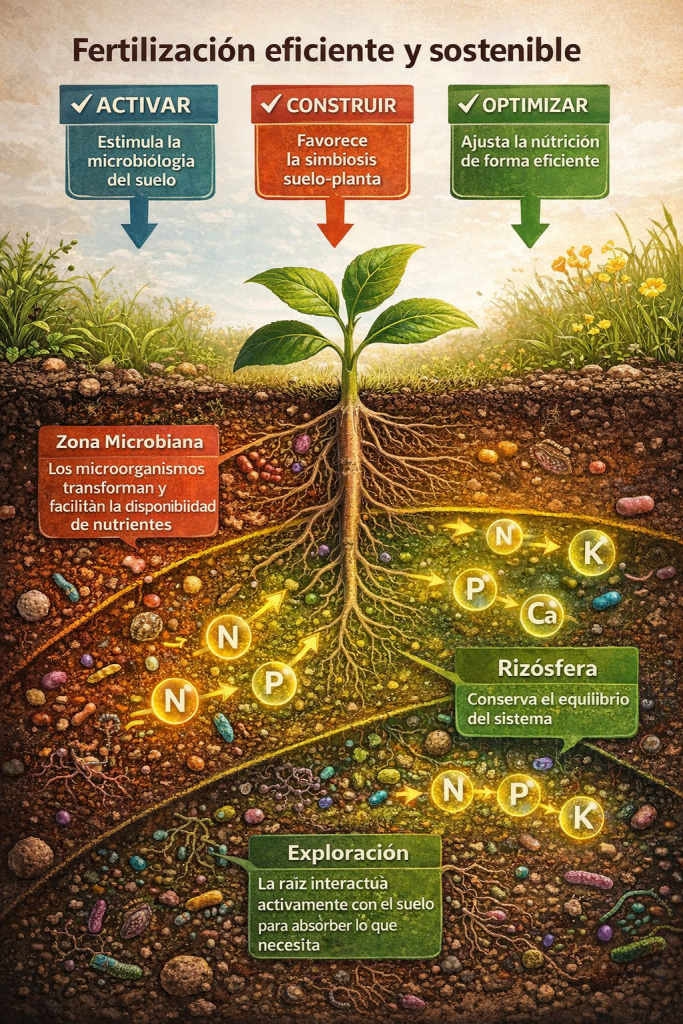
La fertilización eficiente y sostenible, está basada en entender el suelo como un ecosistema vivo, no solo como un soporte para la planta.
Fertilizing is not about directly “feeding” the plant, but about activating the soil-plant system so that nutrients are available naturally, in a balanced and lasting way.
Proposed 4-step method
- Activate: Stimulates soil microbiology to improve its natural fertility and nutrient availability.
- Build: Promotes the soil-plant symbiosis, strengthening roots and improving nutrient absorption.
- Optimize: Efficiently adjusts nutrition according to crop, soil and time, reducing losses and unnecessary inputs.
- Maintain: Preserves the balance of the system throughout the campaign, ensuring productive stability and long-term sustainability.
What happens on the ground
- The soil is divided into zones (microbial, exploration and rhizosphere).
- Microorganisms transform nutrients into assimilable forms.
- The root actively interacts with the soil to absorb what it needs.
Main benefits
- Fewer inputs, more living soil.
- Greater nutritional efficiency.
- More vigorous and resistant plants.
- Mejora del rendimiento y calidad de la cosecha.
- A more stable and sustainable production system.
In summary: more value in the harvest with less dependence on inputs, thanks to intelligent management of soil biology, which is also controlled by sensors, leads us to true precision agriculture. 🌱
Soil moisture sensors
- We measured the water content available to the plant.
- They allow for adjusting irrigation and fertigation.
- Prevent nutrient leaching.
- Typical depths: 10, 30, 60 and 90 cm.
Soil temperature sensor
- They measure biological activity and root development.
- They determine when to apply fertilizers.
- They evaluate the nitrogen mineralization.
Electrical conductivity (EC)
- It measures dissolved salts in the soil.
- Detects salinity at different depths.
- Adjust fertilizer dosage.
- Very useful in fertigation and intensive crops.
 English
  Spanish